
Long before the modern world coined buzzwords like "regenerative agriculture" and "carbon-neutral farming," the Mallah fishing and farming community of Mithila had perfected a zero-chemical, closed-loop wetland aquatic ecosystem that has flourished for over 1,500 years.
1. The Alluvial Silt Miracle of Northern Bihar
Mithila's wetland depressions (*chaur*, *pokhari*, and oxbow lakes) are naturally fed by the annual glacial silt deposits of the Kosi, Kamla-Balan, and Gandak rivers. This fine alluvial clay is rich in natural potassium, calcium, and mineral iron.
Because the decaying biomass of lotus foliage continuously enriches the pond floor, Euryale ferox plants require zero synthetic NPK fertilizers, chemical growth regulators, or chemical sprays. The entire cultivation cycle relies purely on natural bio-sediment.
2. Benthic Diving: The Courageous Mallah Harvest (Gaaj)
Between July and September, when the prickly spiny pads decay and float to the banks, the black seed pods rupture, sending thousands of hard-coated seeds (*gori*) settling into the bottom mud layer (1 to 2 meters deep).
- Mallah harvesters dive underwater repeatedly for 30 to 45 seconds at a time without oxygen gear.
- Using a concave bamboo dredging scoop called a Kaara or Gaaj, they skim the muddy floor, scooping up seeds while filtering out silty clay.
- The harvested black seeds are gathered in floating wooden dugouts (*dongas*) or hand-woven reed baskets (*chhattas*).
3. Traditional Sun Drying & Cast-Iron Popping
Unlike industrial extruded snack pellets that undergo high-pressure steam extrusion in chemical factories, authentic Mithila Makhana is transformed through thermal shock:
- Sun Curing: Raw seeds are cured on clean bamboo mats under natural sunlight until core moisture reaches exactly 9-11%.
- Earthen Pan Roasting: Cured seeds are roasted in earthen and cast-iron pans over steady wood-fired hearths.
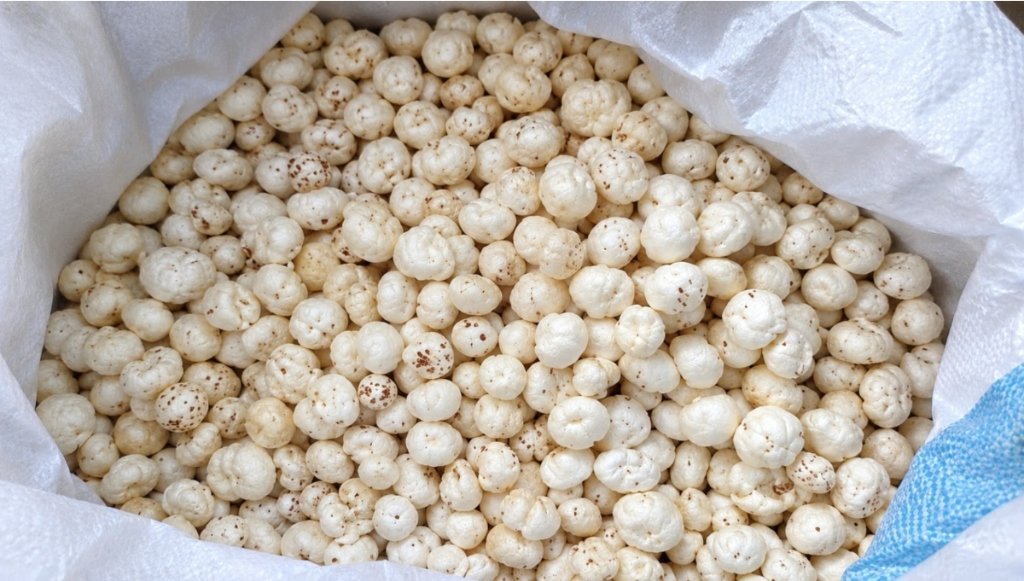
- Instant Wooden Thapi Popping: The blistering hot roasted seeds are scooped onto a wooden block and struck with a hand-carved mallet (*thapi*). The hard black shell fractures instantaneously, and the white perisperm pops open into a fluffy, crunchy sphere.
This ancient heritage process produces a wholesome, unbleached, additive-free superfood that connects rural Mithila farming families directly to conscious global dinner tables.